Augustus Caesar's War on Fake News: What Rome's Propaganda Machine Tells Us About Trust
Augustus Caesar's War on Fake News: What Rome's Propaganda Machine Tells Us About Trust
In 31 BC, Octavian defeated Mark Antony at the Battle of Actium and found himself the sole power in a Mediterranean world that had spent a generation watching strongmen lie to it. Julius Caesar had been assassinated. Antony had been painted as a traitor bewitched by an Egyptian queen. Competing factions had circulated their own versions of every major event for decades. The Roman public, by any reasonable measure, had no reliable way to know what was true.
Octavian—soon to style himself Augustus, the revered one—faced a legitimacy crisis that no army could fully resolve. What followed was one of history's most deliberate and psychologically sophisticated campaigns to shape public belief. And the levers he pulled are not ancient curiosities. They are the same levers that researchers at places like MIT's Media Lab and the Reuters Institute study when they try to understand why misinformation spreads and why some institutions earn trust while others bleed it.
The Information Environment Augustus Inherited
Before print, before broadcast, before the internet, Rome still had an information ecosystem—and it was chaotic by design. Political graffiti covered the walls of Pompeii. The acta diurna, a kind of hand-copied daily gazette Julius Caesar had formalized, circulated news of Senate proceedings and public events. Rumors traveled through the subura, Rome's densely packed working-class neighborhoods, with the speed and distortion that any sociologist of rumor would recognize immediately.
What made the late Republic particularly volatile was the collapse of what psychologists call source credibility. When every faction claims to represent legitimate Roman tradition, and when those factions have been visibly killing each other for decades, the audience's ability to apply any consistent trust heuristic breaks down. This is not a uniquely ancient problem. Studies on contemporary polarization—including work by researchers Brendan Nyhan and Jason Reifler on the persistence of political misperceptions—document the same dynamic: once institutional credibility fractures, correction becomes extraordinarily difficult because the correcting institution is itself distrusted.
Augustus understood this intuitively, even without the vocabulary of social psychology.
Monuments as Message: The Architecture of Consensus
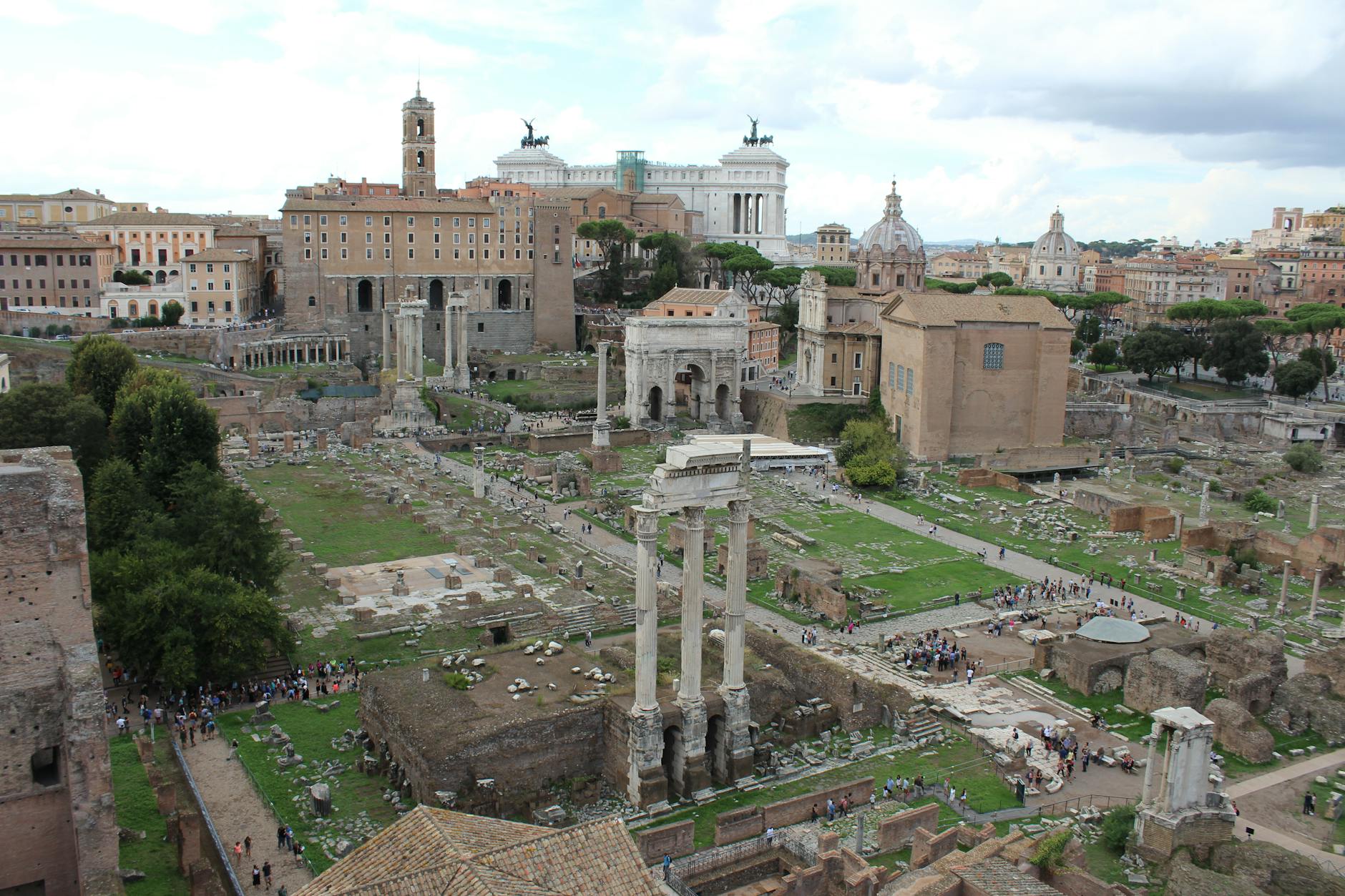
The first tool Augustus deployed was the built environment. The transformation of Rome under his reign was so extensive that he reportedly boasted of finding a city of brick and leaving one of marble. But the Ara Pacis, the Forum of Augustus, the restored temples across the city—these were not merely aesthetic projects. They were inscribed arguments.
Monumental inscriptions served a function that modern communication researchers call repetition-based illusory truth. The psychological phenomenon, documented experimentally since the 1970s, holds that statements encountered repeatedly feel more credible, regardless of their verifiable accuracy. Augustus's version of his own biography—the Res Gestae Divi Augusti, a first-person account of his achievements inscribed on bronze tablets outside his mausoleum and copied across the empire—was not read once and forgotten. It was architecturally embedded into public space. You could not walk past the relevant monuments without absorbing its claims.
The content was carefully calibrated. Augustus presented himself not as a revolutionary autocrat but as a restorer of Republican tradition—a framing that lowered the psychological threat response in a population that had been conditioned to fear kings. He declined the dictatorship publicly and ostentatiously. The princeps, the first citizen, was a title designed to sound modest while consolidating unprecedented power. This is what researchers studying motivated reasoning describe as frame alignment: packaging new information in the cognitive clothing of existing, trusted categories.
Poets on the Payroll: Narrative Override
Augustus's patronage of Virgil, Horace, and Livy was not coincidental. Virgil's Aeneid provided Rome with a founding mythology that positioned Augustus as the destined culmination of Roman history—literally prophesied by the gods. Horace's Carmen Saeculare was commissioned for the Secular Games of 17 BC, a state ceremony designed to mark the beginning of a new golden age under Augustan rule.
The psychological mechanism here is one that behavioral economists have spent considerable effort documenting: narrative transportation. When an audience becomes absorbed in a story, its capacity for analytical scrutiny decreases. Facts embedded in compelling narrative are evaluated differently—more charitably—than facts presented as bare claims. Augustus was not simply disseminating favorable information. He was embedding that information in some of the most aesthetically powerful literature in the Western tradition.
This is not to diminish Virgil's genius. It is to note that genius was being directed. The Augustan literary program was state-sponsored content at a scale and quality that no modern government communications office has matched.
Where the System Failed: The Limits of Narrative Control
And yet, Augustus's information environment was not airtight—and its failures are as instructive as its successes.
Rumor remained ungovernable. The historian Suetonius records numerous scandalous stories about Augustus's private life that circulated despite his image management. His daughter Julia's very public romantic adventures became a political crisis that no amount of monumental inscription could suppress, because the stories were too entertaining, too personally relevant, and too widely witnessed to be countered by official narrative.
This maps precisely onto what researchers studying misinformation today call the negativity bias and novelty premium in information sharing. Surprising, emotionally resonant, socially transgressive information travels faster and farther than corrective, authoritative information. Augustus could control the walls. He could not control the dinner party.
More significantly, the Augustan system depended on the personal credibility of Augustus himself. When that credibility was intact, the broader information architecture held. When Augustus died and the succession passed to Tiberius—a far less skilled communicator who retreated to Capri and allowed the Senate to operate in an atmosphere of paranoia and denunciation—the entire system of managed consensus began to corrode. Trust in institutions, research consistently shows, is built slowly through demonstrated competence and consistency, and destroyed rapidly through perceived betrayal or incompetence.
Tiberius did not rebuild the monuments. He did not cultivate the poets. And Rome's information environment became correspondingly more chaotic.
What Five Thousand Years of Data Suggest
The lesson that Augustus's experiment offers is not that propaganda works—though it does, within limits. The deeper lesson is about the conditions under which authoritative communication earns versus loses public trust.
Augustus succeeded for as long as he did because his narrative, however self-serving, overlapped sufficiently with lived Roman experience. After decades of civil war, people genuinely wanted stability, and stability genuinely arrived. The monuments were not lying about the peace. They were framing a real condition in favorable terms.
When institutions today lose the public's trust in their communications—whether those institutions are public health agencies, news organizations, or elected governments—the mechanism of failure is usually the same one that eventually undermined the Augustan system: the gap between official narrative and lived experience became too wide to paper over with any volume of messaging.
Two thousand years separate Augustus from the current debate over misinformation and institutional credibility. The psychological architecture of the audience has not moved an inch.