Civic Duty Has Always Had a Bill Attached: The Hidden Economy of Voluntary Obligation

Photo by Photo by Chintya Akemi Keirayuki on Unsplash on Unsplash
Somewhere in your professional past, there is almost certainly an entry on a résumé that reads 'volunteer experience.' You added it because it signaled character. The organization that received your labor added nothing — except, perhaps, a letter of recommendation that cost them thirty minutes. Both parties understood the transaction implicitly. Neither called it what it was.
This arrangement is not modern. It is not even recent. It is, by the available evidence, approximately as old as organized society itself.
The Roman Precedent Nobody Mentions
The munus — a Latin term that translates, depending on context, as 'gift,' 'duty,' or 'public obligation' — was one of Rome's most effective administrative instruments. Wealthy citizens were expected to fund public games, repair roads, and underwrite civic infrastructure. Refusal was technically possible. Social annihilation was the reliable consequence of refusal. The Roman state had, in effect, created a system in which the compulsion was entirely distributed among one's neighbors, and the treasury paid nothing.
Below the propertied class, the corvée — labor obligations extracted from peasants and freeholders — operated on a similar psychological architecture. The work was framed as participation in the common good. The Latin root of the word corrogare, to requisition, was politely obscured beneath language about community and shared purpose. Historians of Roman administration have noted that the corvée was enforced less through direct coercion than through the social impossibility of being the household that refused while everyone else complied.
This is not a minor distinction. It is the central mechanism.
The Medieval Parish and the Art of Moral Accounting
Medieval European Christianity refined the model considerably. The tithe was, formally, a religious obligation — a tenth of one's income rendered unto the Church. But surrounding the tithe was an entire ecosystem of labor obligations: the repair of church buildings, the maintenance of parish roads, the provision of hospitality to traveling clergy. These were not legally mandated in most jurisdictions. They were, however, morally mandatory in a society where the parish was simultaneously a religious institution, a social network, and the primary mechanism of community belonging.
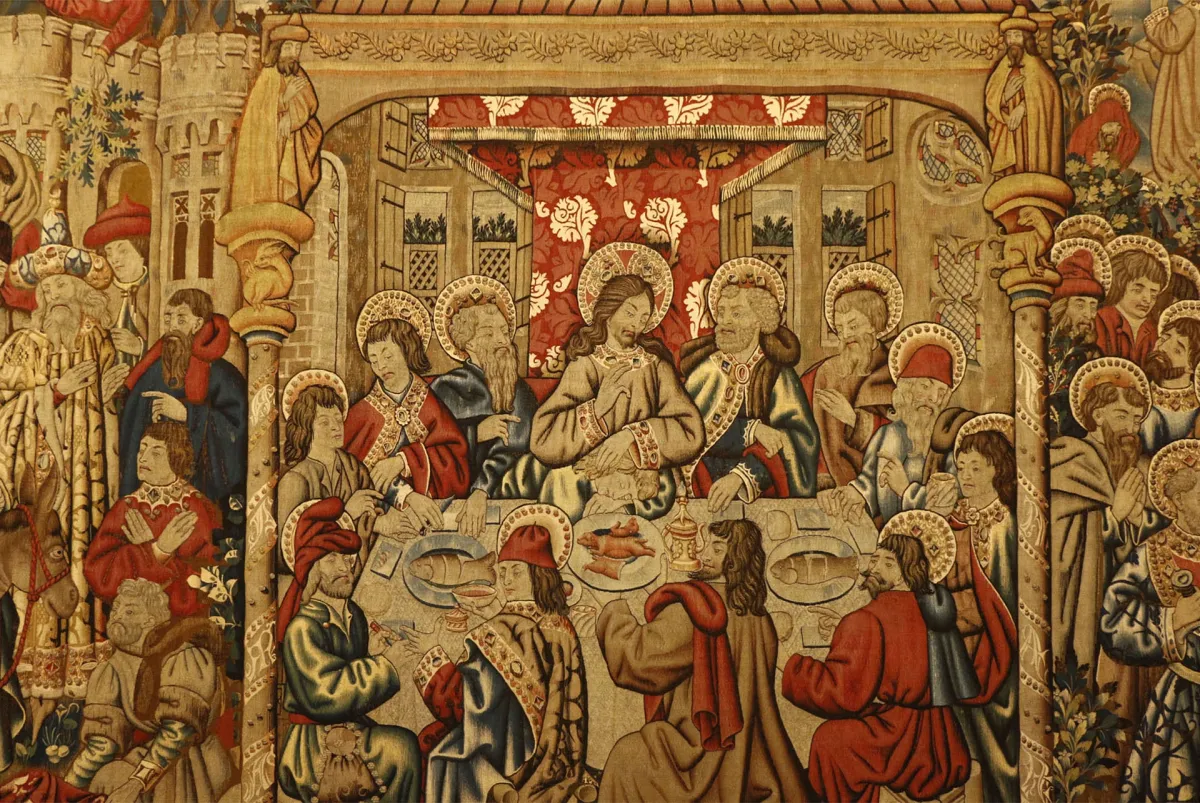 Photo: Medieval European Christianity, via get.pxhere.com
The psychological leverage was explicit in the theological literature of the period. Contributing labor was framed as an act of piety. Withholding it was understood as a declaration of spiritual inadequacy. The Church had discovered — or, more accurately, inherited from Rome and refined — the principle that shame is a more efficient enforcement mechanism than law, because shame requires no bureaucracy.
Craft guilds extended the principle into secular commerce. Apprentices provided years of essentially free labor in exchange for training and eventual membership. The arrangement was presented as mutual benefit. The power differential embedded in it was not a flaw in the system; it was the system.
The Psychology of the Unpaid Exchange
Social psychologists studying what researchers call 'communal norms' have documented a consistent finding: when a transaction is framed as a relationship rather than an exchange, people reliably accept terms they would reject in any explicitly commercial context. This is not irrationality. It is, in fact, a sophisticated response to a real social calculus — belonging has genuine value, and people are often making accurate assessments when they conclude that the social cost of refusal exceeds the economic cost of compliance.
The problem arises when institutions learn to exploit this calculus deliberately. The research literature on unpaid internships — a subject that has generated considerable academic attention since the 2010s — consistently finds that interns perform work of measurable economic value while accepting non-compensation because the credential and the network access are framed as the 'real' compensation. The framing works. It has always worked. It worked in Rome.
What the psychological research adds to the historical record is a vocabulary for the mechanism: reciprocity norms, social identity theory, the well-documented human tendency to avoid being the defector in a cooperative arrangement. These are not cultural artifacts of any particular era. They are features of the species.
The Volunteer Economy, Formally
The twentieth-century American nonprofit sector institutionalized the model at scale. The United States currently counts volunteer labor as a significant component of social service delivery — estimates from the Bureau of Labor Statistics have placed the annual volunteer contribution in the billions of hours. The sector depends on this contribution in ways that are rarely stated plainly: without unpaid labor, large portions of American civil society would require either substantial public funding or would cease to function.
 Photo: United States, via i.pinimg.com
This is not a criticism of volunteerism as a personal choice. It is an observation about structural dependency. When an institution's operating model requires free labor to remain solvent, the 'voluntary' nature of that labor is doing considerable ideological work. The medieval parish needed its parishioners to repair the roof. The parish did not advertise this as a labor extraction system. Neither does the modern nonprofit sector.
The language shifts across centuries — munus, obligation, service, giving back — but the underlying transaction remains stable. An institution that cannot or will not pay market wages for necessary work discovers that civic language, moral framing, and social belonging can substitute for a paycheck with remarkable reliability.
What the Record Suggests
Five thousand years of administrative history contain no example of a society that, upon discovering it could obtain labor through social obligation rather than direct compensation, declined to do so. This is not evidence of conspiracy. It is evidence of a stable equilibrium: the arrangement persists because it works, and it works because the psychological mechanisms that make it work are not culturally specific. They are human.
The college student adding 'volunteer coordinator' to a résumé, the junior attorney doing pro bono work for bar association credit, the neighborhood association member who somehow ends up running the annual fundraiser every year — each is participating in a system with a documented lineage stretching back to the earliest administrative records available to historians.
The hidden price of voluntary obligation is not always economic. Sometimes it is time. Sometimes it is the social impossibility of saying no. Sometimes it is the gradual discovery that the credential, the network access, or the community belonging that was promised as compensation was worth considerably less than advertised.
The Roman citizen who funded the games knew this. He funded them anyway. The social math left him no other option — and five thousand years of evidence suggest that this particular equation has not yet found a solution.