The Neighbor as Agent: Why States Have Always Found Surveillance Cheaper When Someone Else Does It

In the summer of 1989, as the East German government was beginning its terminal collapse, the Ministry for State Security — the Ministerium für Staatssicherheit, universally known as the Stasi — employed approximately 91,000 full-time officers and maintained a network of roughly 180,000 registered civilian informants. The ratio, approximately one informant for every sixty-three East German citizens, has become the standard reference point for discussions of modern authoritarian surveillance.
 Photo: East German, via cdn.britannica.com
The Stasi's achievement was real. It was also, in the context of five thousand years of administrative history, neither original nor particularly surprising. The state that discovers it can recruit its citizens to monitor one another has discovered something durable: that the surveillance budget can be reduced to nearly zero if the social conditions are correctly arranged.
The conditions, it turns out, are not difficult to arrange. They appear to be approximately universal.
The Baojia and the Arithmetic of Collective Responsibility
The baojia system, formalized in China during the Song Dynasty in the eleventh century CE but with documented antecedents stretching back to the Zhou period, organized the rural population into nested units of households — typically groups of ten, then one hundred, then one thousand — each of which was collectively responsible for the conduct of its members. If a household within the unit harbored a criminal, committed a violation, or failed to report suspicious activity, the entire unit faced penalties.
 Photo: Song Dynasty, via media.geeksforgeeks.org
The administrative elegance of the system lay in its elimination of the monitoring problem. The state did not need to watch every household. It needed only to create conditions in which every household watched every other household, because the consequences of a neighbor's transgression were shared. The incentive to report was not ideological. It was actuarial.
Variants of the baojia model appear in the administrative records of virtually every major agrarian empire. The Ottoman mahalle system organized urban neighborhoods around collective accountability. Aztec calpulli units had internal governance structures that included reporting obligations. Roman collegia — neighborhood associations — were required to maintain records of members and, under certain emperors, to report politically suspicious activity.
The pattern is consistent enough to suggest that it represents not a specific cultural invention but a general administrative discovery: when you make neighbors responsible for each other, they will, under sufficient pressure, surveil each other without being asked.
The English Parish and the Moral Informant
Medieval English ecclesiastical governance developed a parallel model through the institution of the churchwarden's presentment. Churchwardens — lay officers of the parish — were required to appear before the bishop's court at regular intervals and present, under oath, any parishioners who had committed moral violations: adultery, failure to attend services, unlicensed trading on Sundays, usury, defamation.
The system was explicitly designed to leverage the informational advantage of local knowledge. A bishop's officer could not know which households in a rural parish were conducting irregular marriages or practicing folk medicine. The churchwarden, who attended the same services, sat on the same village green, and watched the same comings and goings, knew everything. The ecclesiastical court simply created a formal channel through which that knowledge could flow upward, and attached to the churchwarden's role enough social prestige to make the reporting function desirable rather than stigmatized.
This is the detail that most administrative histories underemphasize: the social architecture surrounding the informant role matters as much as the formal obligation. The churchwarden was not a snitch. He was a pillar of the community performing a civic duty. The reframing was not incidental. It was the mechanism.
Colonial America and the Informing Tradition
Early American colonial governance inherited the English model and adapted it to frontier conditions. Puritan New England's system of community oversight — in which congregational membership required submission to collective moral scrutiny, and in which neighbors were expected to report violations of the community covenant — is well documented in the historical literature. The Salem witch trials of 1692 represent the catastrophic failure mode of this system, but they should not obscure the extent to which the underlying architecture of neighbor surveillance was considered normal, legitimate, and religiously mandated by the communities that practiced it.
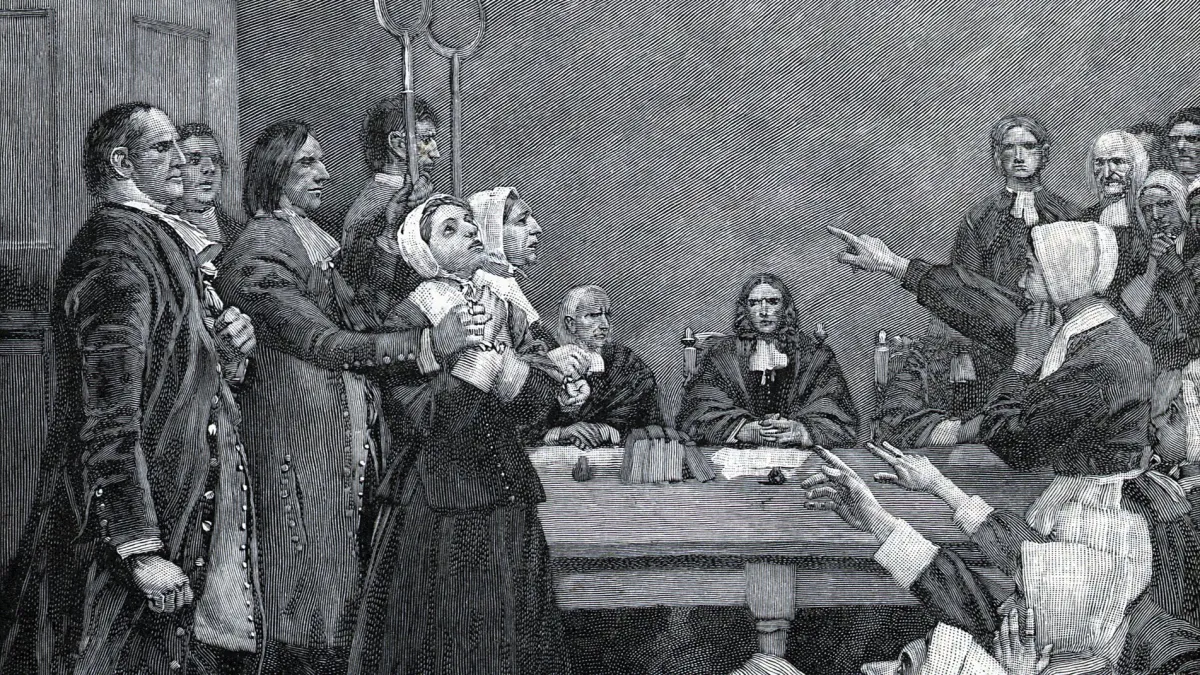 Photo: Salem witch trials, via assets.editorial.aetnd.com
The American tradition of civilian reporting has persisted in forms that are rarely framed as surveillance. The IRS whistleblower program pays informants a percentage of recovered taxes. Crime stoppers tip lines are standard infrastructure in American law enforcement. Neighborhood watch programs — which the National Sheriffs' Association estimates involve millions of American participants — are explicitly organized around the principle that residents should monitor and report on one another's activity.
The language in each case is carefully calibrated to distinguish the activity from informing: it is 'community safety,' 'civic participation,' 'protecting your neighborhood.' The functional description of the activity — ordinary citizens collecting and transmitting information about their neighbors to state authorities — is the same in every case.
The Psychology of the Willing Informant
The question that the historical pattern raises most insistently is not why states create these systems. The administrative logic is transparent. The question is why ordinary people, across every documented culture and century, prove so reliably willing to participate in them.
The psychological research offers several converging explanations. Studies of informant behavior in authoritarian contexts — drawing on interview data from former East German, Soviet, and Romanian civilian informants — consistently find that ideological commitment was a minority motivation. The more common drivers were social pressure, the desire for institutional approval, the resolution of pre-existing personal grievances, and what researchers have termed 'moral licensing' — the phenomenon by which framing a transgressive act as civic virtue reduces the psychological cost of performing it.
The last mechanism deserves particular attention. Experimental work in social psychology has demonstrated that people who have recently performed an action they consider morally positive are subsequently more willing to perform actions they would otherwise avoid. When reporting on a neighbor is framed as an act of community responsibility rather than betrayal, the internal accounting changes. The informant is not a betrayer. The informant is a protector. The neighbor who is reported is not a victim. The neighbor is a threat that the community's responsible members have neutralized.
This reframing is not a product of authoritarian indoctrination. It is a feature of normal human moral psychology. It is why the baojia household and the New England congregant and the East German Inoffizieller Mitarbeiter and the contemporary neighborhood watch participant all made and make essentially the same psychological move — and why none of them, in the moment of making it, experienced themselves as participants in a surveillance system.
The Consistent Discovery
Every state in recorded history that has faced the problem of monitoring a large population with limited resources has eventually arrived at the same solution. The solution is not technology. Technology is expensive and requires maintenance. The solution is social architecture — the arrangement of incentives, identities, and obligations such that the population monitors itself.
The Stasi's 180,000 informants were not an aberration of twentieth-century totalitarianism. They were the latest iteration of a model that Song Dynasty administrators, medieval English bishops, and Puritan New England congregations had each independently developed and refined. What varied across these contexts was the ideological vocabulary used to recruit participants and the technological infrastructure used to process the information they provided.
What did not vary was the discovery that the most efficient surveillance network ever designed is the one that every society builds without calling it surveillance — the one staffed entirely by people who believe, with complete sincerity, that they are doing something else entirely.